Thursday, December 25, 2025

Jokers, Fools, Tarot Decks, and Fortune Telling

 I am a joker collector yet I have at least two dozen tarot decks in my collection. Here's a few of them.

Tarot decks (some) in my collection. And Oracle decks.

Rather than speculate on why these decks have compelled me to buy them, I will focus on a joker collector's perspective of tarot decks.  And my thoughts on how the joker came to be.

Tarot Decks? Quick reminder: A tarot deck consists of the 52 cards found in a modern deck (the Minor Arcana)  plus 22 more cards known as the Major Arcana.  Twenty-one of these cards are numbered: Only the Fool card does not have a number. The Magician is #1, the High Priestess is #2, and the Empress and Emperor are numbers 3 & 4. Number 5 - Actually, it's usually Roman Numbers so "V" - is the High Priest or Hierophant, VI is the start of a new part of the major arcana where the cards rather than representing specific roles, represent elements of  human behavior. So VI is the Lovers. And so on. BTW, some of my decks above are Oracle or divination decks which are different than tarot decks.  Oracle decks can be just a collection of symbols or a regular 52 card deck with additional symbols used for fortune telling, divination, or inspiring insights.

More of my 
Tarot and Divination Decks

As an American, I think of tarot decks primarily for divination and fortune telling.  If I lived in Europe, I would know that the tarot deck is for a popular game called tarot. In France for instance, tarot is the second most popular card game (per wikipedia). Games with tarot decks are popular through-out Europe except for the British Isles and the Iberian Peninsula  (again, per wikipedia).

I recently started improving my understanding of the tarot deck aided by Taschen's 500 page tome.

Tarot by Taschen

When did tarot cards become associated with divination?  In 1781, a Count de Gébelin published an essay associating tarot cards with ancient wisdom. As it turns out, this was totally invented (ie not historically true!) but these theories took on a life of their own and since then, particularly in the United States, tarot cards have been used for divination.

An ongoing question about tarot decks is about the relationship between the Tarot Fool card and the joker card in normal decks. 

The Fool Card from some of my tarot decks

On the web and in conversation, one often hears that the joker evolved from the fool in tarot decks. This  is not true. But it is often repeated and believed.  After all, look at the tarot Fool card below, doesn't it look like a jester that we might see on jokers?  It seems easy to believe that the Fool card, which existed for 500 years prior to the invention of the joker, directly led to the addition of the joker to the 52 card deck.  But again, it is not true. Or at least, it is a lot more complicated than that.

The Fool from The Gilded Tarot
by Ciro Marchetti 

The most likely history is that the joker was developed in the 1860s in the US for the game of euchre. Euchre is a trick-taking game where the trump or highest card was called The Bower.  It seems that the players (and publishers) added a best bower card, a sort of super wild card for the game of euchre. A Samuel Hart of New York and Philadelphia published  what some consider to be the first joker ever, the Imperial Best Bower. This card is nicknamed the Doghouse card ( Hochman Encyclopedia where it is on Page 54, NY36) based on its design.  But, I do NOT consider these Best Bower cards to be jokers. I  think of them as the immediate predecessors to jokers.

The Dog House Imperial Bower - 1863
 
My position: Saying that the Doghouse Best Bower card is the first ever joker feels wrong to me.  Very Wrong!  To my way of thinking, if it doesn't say Joker, it's not yet a joker. Yes it's a wild card but in my book, it's not a joker. The trademark or blank cards that were sometimes shipped with decks would have almost a co-equal claim to being the first jokers. 

There were a number of Best Bower cards published in the same period.  Here's mine:

Best Bower Cards (from Hochman)

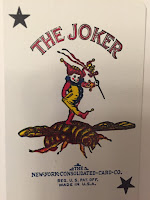
The first card published labelled as a joker is probably this one, published in 1871. 

NY16  'The Joker' 1871
(not 1860 as listed in Hochman)

The Heathen Chinese Card. NY16 1871. It appears that the NY16 deck could be the first time a card was labelled The Joker. The card featured an illustration of a card game amongst a number of cheats, one of whom was Chinese. It was story told in a poem published in 1870 by Bret Harte. There's more background about this poem and image in this article.  While Hochman says the card is copyright 1860 by the New York Consolidated Card Company  (NY16 JNO J Levy), everyone now seems to agree that this date is wrong and the most likely date for this card is 1871, the year after the poem was published.  This later date still leaves this card as the first one to use the word joker.  

More Background on the first use of the word Joker for playing cards...

Phil Neil's Article.  (published Feb 2019, updated in 2022) is a well-researched article which both debunks the euchre-to-juker-to-joker story and provides additional information on the use of the word joker around playing cards in that era.  Phil emphasizes that there is no evidence supporting the concept of the joker having an intermediate period Best Bower phase when it was known as the juker card.

Phil Neil insists that it became clear that the blank card being used as a wild card or best bower could be best integrated in the deck as a court member - the court jester or joker - who belongs in the court with the kings, queens, and jacks.  He also argues that  the concept of the Fool card as a wild trump card in the tarot decks and games was known in the US at that time because the game of tarot was being played.  This was when tarot was known as a game and a deck with 54 cards, not as a fortune telling deck with 78. Also, "Another source on cards was the book Facts and Speculation on the Origin of Playing Cards(17), 1848, by William Andrew Chatto".

Phil says that an early form of poker - Brag - was popular in the mid 1800s and used the J (jack of clubs) as the wild card.  Euchre also used the jacks as bower card and so it was natural to see both of them as similar wild cards.  Phil also documents that the Yankee Notion publishing house introduced cards in the 1850s which were popular for several decades. These cards were not the common deck and were introduced since regular decks were often associated with gambling and were often not considered appropriate for wholesome family entertainment. In the games and cards that the Notion introduced, there were cards called the jokers.

In 1852, Thomas W. Strong published a popular humor magazine entitled “Yankee Notions.” Then in 1856, he designed new playing cards totally different from the classic cards for a series of 16 new games which he named Yankee Notions. His purpose of designing these new games was to give card players some alternatives instead of using traditional cards which were associated with gambling vices. Strong’s Yankee Notions were first published in Hoyle’s Games(12)in 1857, edited by Thomas Frere, and were also in several other later editions as well. When his new games were published, the newspaper, New York Commercial Advertiser, stated, “We are glad to see something in the way of domestic games, and social amusement, that we can recommend, not only for scientific and instructive character, but for its good moral influence(11).” These games were popular for at least thirty years (1857 - 1887) for those not wanting to use classic cards and games.

Strong devised three elements different from classic cards: reduced the deck to 50 cards, initiated five suits, and added all new names. One of the Yankee Notions games of major importance as related to the development of the joker was called “Black Joke.” In this game, all ten face cards were called Jokers and were printed with various humorous characters.

Source: https://hobbylark.com/card-games/The-History-of-the-Joker-Card

So this nuanced view, somewhat confusing, is that the Best Bower for Euchre established a role for a wild card to be added to the 52 card deck and that the use of the term joker or jester, which was known within the card publishing industry was coopted so the bower phase was replaced by having a jester who seemed to fit so well with the royal court of jack, queen, and king.

The first publication of the word “Joker” in a book associated with the game of euchre appears in The Modern Pocket Hoyle 4th ed. in 1868, by “Trumps(16)The Modern Pocket Hoyle lists a variant game called Railroad Euchre. Quoting from this Hoyle, “A Euchre pack is usually accompanied by a specimen blank card which has given rise to this amusing variety of the game of Euchre. It is called “the Joker,” highest trump card, and ranks above the right bower.”

Related articles on this site:

The Louvre's Exhibit of the Court Jester or Fool


Sunday, December 21, 2025

Inky Dinky Bag of Bones Transformation Deck

 Transformation Decks are a creative artform that transforms playing card suit signs into pictures. They  originated in the early 1800s in Germany.  Want to know more about them?  So did I so I bought myself a copy of Transformation Playing Cards by Albert Field, Published by US Game Systems in 1987.

Note I have two other articles about my transformation decks:
  • Three more recently acquired decks: Vanity Fair Transformation Deck of 1895, Fronmann and Bunte or Jeanne Hachette 1870 Transformation Deck, and  Circus Transformation Deck by F. Robert Schick, 1988
  • Eight decks: The Royal Mischief deck, Aesops Fables by Elaine Lewis, 2000PIPS and Wild! by Peter Wood,  A Motley Pack, Comic Eclipse Deck  is the first American-designed transformation deck, Een Hollands Transformatiespe, and  Ackermann Bartlett 1818 Transformation Playing Cards USPCC.
This article describes the Inky Dinky Bag of Bones transformation deck.  First the front and back of the box.


Here's the ace, two, and three of diamonds. Now by the strictest definition of transformation decks, this deck would not qualify since while the pips are integrated into a picture, they don't stay in their original places


My other article on transformation decks:
Three transformation decks: Vanity Fair Transformation Deck of 1895, Fronmann and Bunte or Jeanne Hachette 1870 Transformation Deck, and  Circus Transformation Deck by F. Robert Schick, 1988
Inky Dinky Bag of Bones Transformation Deck - This article
My Repro Jeanne D'Arc transformation deck 

Or, to  keep reading learning about cards, particularly jokers. Here's some articles to read next:


Friday, November 21, 2025

Latin Decks are Different

Two of my friends recently bought decks for me from their travels. These decks were both bought in Latin countries (Spain and Italy) so they are not American-style decks. For those of you who don't know, American decks are largely the same as British decks which are almost the same as French which is where our decks descend from.

Both of the gifted decks (and thank you both very much) were in the category that I think of as Latin decks. In this case, the decks came from Spain and Italy, specifically from Sicily.  How are Latin decks different? Well, let's look.

The Suits, Example: Clubs: Like American decks, they have a suit called clubs. But their clubs look like real clubs, like the sort of club a Fred Flintstone might have used.   Here is the five of clubs and two of clubs from these decks.

A Latin-style Five and Two of Clubs
 
Suits. Here are the four suits from the Spanish deck. They have Swords (like our Spades),  Coins (like our Diamonds), Cups (like our hearts), and Clubs, which we've already looked at. These are the same suits from the Sicilian deck.  Notice any red or black suits?   

Suits of the Spanish Deck:
Swords, Coins, Cups, and Clubs

Size. You might also notice that these two decks are different sizes. And neither is exactly the same size as an American deck.  Here is the three of swords (or spades) from left to right of the Sicilian deck, an American deck, and the Spanish deck.


Colors: This is another big difference. Obviously (from looking at the deck), they don't have the red versus black suits.  But from looking at it, I could maybe discern a split based on the amount of red or shapes. So I turned to AI to check and was assured that they do NOT have anything comparable to the red vs black suit of our American (British/French) decks.

Face Cards / Royalty. American decks have a well-established court of a jack, a queen, and a king.  The Spanish deck has a Knave (Fante in Italian, Sota in Spanish),  Knight (Cavallo in Italian, Caballo in Spanish), and a  King (Rey/Re).   And NO Queen!
 
The Six Highest Club Cards
in the Spanish deck

In the picture above, I showed the six highest cards in the Spanish deck.  If you look at the clubs, you'll notice that I have the seven, the eight, and the nine.  No ten!  Yes, that's right, this deck has no tens! So it only has 48 cards.

Trademark card. In American decks, the ace of spades is traditionally very ornate.  This descended from England where the stamp tax was placed on the ace of spades to show that the tax had been paid. In the Latin decks, it's the one of coins that is the most ornate card in the deck.  (Turning to AI). The one of coins in Latin decks often features a special, ornate design for two main reasons: as a canvas for the printer's mark or tax stamp, and to highlight its symbolic significance as a representation of material abundance and the element of Earth.  Here are the two ornate ones of coins.

The Most Ornate Cards - Trademarks

Here are the four ones from the Spanish and Sicilian decks so you can see how the One of Coins got the most elaborate treatment. The One of Coins, like our ace of spades, doubles as a trademark card.  The four Spanish suits:  Los Oros (Coins/Gold), Copas (Cups), Espadas (Swords), y Bastos (Clubs)

Ones of Coins, Swords, Clubs, and Cups
The Trademark in the Spanish Deck
is the One of Coins card

Here are the four ones from the Sicilian Italian deck of cards

Ones of Coins, Swords, Clubs, and Cups
The Trademark is one the Coins card
Sicilian Deck

Number of Cards. Here are six most valuable cup cards in the Sicilian deck.  There's the king, knight, and knave. And the highest number card is a seven.  So they have only ten cards in each suit as opposed to the thirteen cards in an American deck. So the Sicilian deck has only 40 cards in it.


Top Six Cup Cards in the Sicilian Deck

The Spanish deck has 50 cards.  There are 12 cards in each suit (remember, no Tens) plus this deck has two jokers.

Spanish Jokers and Back

Sicilian Box
(The Spanish deck did not have a box)

Quick PS. In looking through my archives, I found another Spanish deck. Here it is. First the one and two of swords with the  three sword face cards noticing again, it's knave knight, and king.

Three Spanish sword face cards:
knave knight, and king.

Here's the face cards and one through four of coins. Notice again that the one of coins, like our ace of spades, doubles as a trademark card.


And here is the two of each of the four Spanish suits: swords, cups, clubs, and coins. Los Oros (Coins/Gold), Copas (Cups), Espadas (Swords), y Bastos (Clubs)


There is a third broad category of European decks of cards: the German decks.  German-suited playing cards are  common in many parts of Central Europe. The packs are made up of 32- or 36-card packs with suits of Acorns (Eichel or Kreuz), Leaves (Grün, Blatt, Laub, Pik or Gras), Hearts (Herz or Rot) and Bells (Schelle, Schell or Bolle). The German suit system dates back to around 1450 and influenced the design of the now international French suit system of Clubs, Spades, Hearts and Diamonds. 

No more to see here, want to go look at the animal subsections of the joker collection?
    1. Ensemble Animal combinations (cats AND dogs)
    Animals: Flyers - Bee Boy
    Animals: Flyers - Bee Boy
    1. Cats  or  Dogs Felines, Canines. And a big cat subsection! 
    2. Flyers:  Birds, Owls, Bees,  Butterflies  & Dragons . With rooster & chicken subsubsection!
    3. Horses , zebras, donkeys, giraffes. Equestrian!
      1. Fantasy horses: centaurs, unicorns, Pegasuses
    4. Monkeys, bears, and other sapiens (yes, missing links jokers go here).  Panda Bears are a subsection.
    5. Animals with antlers, horns, and tusks
    6. Varmints - the small wild animals
    7. Reptiles, amphibians, sea creaturesmermaids, shell fish,

Tuesday, October 28, 2025

More Transformation Decks - Chasing Hochman's List

If you don't know what a transformation deck is, jump over to my article explaining transformation decks.

Transformation Decks Build the Pips into an Image

At the most recent 52 Plus Joker Conference in Charlotte NC, I first heard about the idea of a Completist Collector. Matt Schacht used the expression in his talk where he self-identified as a Completist Collector meaning (as I understand it), a collector who likes having a defined finite list of items which he tries to collect all of. As an example in his case, he focused on The Souvenir Decks mentioned in Hochman Chapter 25. 

So I looked at the Transformation decks mentioned by Hochman in Chapter 18 and if I count the modern reproductions (which is as cheesy as can be), I have 6 out of the 15 that Hochman mentions. Here's the status of my collection in completing a collection of the 15 trans decks that Hochman lists. 

Hochman Transformation Decks - Chapter 18
V 11-14-2025
YearDeckMinePublisherCommentsReprints
T11833BARTLETT2023 reprintCaleb Bartlett, NY,Identical to three decks produced Europe ~15 years earlier, known as Beatrice or Fracas,2023
T21860Samuel HartSamuel Hart & Co.,copied from Braun and Schneider, Munich, Germany ten years earlier
T2a1860Samuel HartSamuel Hart & Co.,minor changes
T31876Eclipse Comicdeck, 52+JF.H. Lowerre, NY,Centennial deck, first original transformation deck to be published in USA
T41879Tiffany HarlequinreprintTiffany & Company, NY,The most artistic of American transformation decks, designed by C.E. Carryl1974
T51883Murphy VarnishMurphy Varnish CoTransformation and advertising deck
T61888Harlequin InsertKinney Tobacco CoCards individually found in Sweet Caporal cigarette packs
T71889Harlequin InsertKinney Tobacco CoCollecting all 53 insert cards earned a full size transformation deck (see T8)
T81889Harlequin InsertKinney Tobacco Cofirst American transformation deck to include courts with transformed pip designs
T91895Hustling Joe I,USPCa clever pseduo transformation deck- see pics
T101895Hustling Joe I,reprintUSPCFixed colored background problem which made deck poor for gamesreprint
T111895Vanity Fairdeck, 52+JUSPCTransformation deck. Courts are clever & comical but not transofrmed
T121896Y Witches Fortune-Tellingdeck, 52+JUSPCMore of a fortune-telling deck but included...
T131905Funny SportContiental PC Co, NYPips had comical faces, every card had a motto or statement
T141977Sutherland-BrownLaura SutherlandTransformation-like


If you don't know anything about Transformation decks, click ASAP to my introductory article about Transformation decks.  If you do understand the concept, then stick around as I move away from the Hochman completist idea and provide some updates on my transformation deck collecting...

Here's descriptions of three of my transformation decks (others are covered in my other transformation deck article): 
  • Vanity Fair Transformation Deck of 1895.
  • Fronmann and Bunte or Jeanne Hachette 1870 Transformation Deck 
  • Circus Transformation Deck by F. Robert Schick, 1988
Vanity Fair Transformation Deck of 1895. This is the first transformation deck by USPC and it is very well done. Here's a few pip cards.

The Five Spades - all in their traditional spot - are
cleverly integrated with five images

The Two of Spades from the 1895
Vanity Fair Transformation Deck 

The Three of Spades from an 1895 Transformation Deck 
Transformation Decks Started in Germany in the early 1800s

The royal cards are not transformed but they are original and humorous. The joker is a devil. A complete set of photographs of the deck is available on the World of Playing Cards (out of England) or on the World Wide Playing Card Museum website (out of Russia by Alexander Sukhorukov).

Vanity Fair Transformation Deck of 1895: Joker, Ace, and Back

Vanity Fair Transformation Deck of 1895 - Humorous Royal Cards


I also recently acquired the Fronmann and Bunte or Jeanne Hachette 1870 Transformation deck published by B.P. Grimaud.  A reproduction deck was printed in 1976 by J. Chr. Sorensen of Copenhagen of a transformation pack. Here's information about it on The World of Playing Cards on Jeanne Hachette and the WWPCM on Jeanne Hachette.  

Jeanne Hachette 1870 Transformation Deck

Jeanne Hachette 1870 Transformation deck - Ten of Hearts


Eight of Hearts - Jeanne Hachette 1870 Transformation deck


Jeanne Hachette 1870 Transformation deck: Ace, Two, or Three of Clubs


Here's a scan (thanks Peter) from Albert Field's Transformation Playing Cards about the Fronmann and Bunte or Jeanne Hachette 1870 original and modern Transformation decks.  (thanks Peter)


The Circus Transformation Deck
was designed by F. Robert Schick. When he died in 1988, his widow worked with Carti Mundi to get the deck published in 1000 copies. My example is 792 and is one of my rare unopened decks.

Here are a few card images of the The Circus Transformation Deck was designed by F. Robert Schick with image credit going to The World of Playing Cards (since my deck remains sealed)


The Jokers of the
The Circus Transformation Deck 
by F. Robert Schick1989

The Cotta Jean of Arc transformation deck was reproduced by Merrimack publishing in 2020 produced by Will Roya, sold by PlayingCardDecks.com, and financed by kickstarter. J.F. Cotta produced the first transformation deck in 1805. He produced a series of six playing card transformation decks.   The repro publisher has a description of the Cotta Jean of Arc deck and its provenance. An original deck exists at the British Museum. There's a great article on transformation decks on WOPC

Cotta Jean of Arc Repro Deck


See also my write up of the Inky Dinky, Bag of Bones, transformation playing card deck which just arrived this week.


Another transformation deck of note (ie, not a modern reproduction) that I own is the the Eclipse Comic Playing Cards Deck. It is described in my previous article on transformation decks. There are also some super interesting modern transformation decks by Peter Wood and by Elaine Lewis. I also, as mentioned in the table above, have some modern reproductions of the best historical transformation decks. Enjoy!